
On the harmless fun of poaching
In which I review a lesser known Roald Dahl gem, get angry at a Russian gentleman, and praise an asshole’s jawline.

You thought this newsletter was dead, didn’t you? Tough luck! I’m back and resurrecting this digital corpse with a shockingly longer newsletter. But why did you need three months to write this, Jonas? Nosy! It has everything to do with a dense, dry and dusty German philosophy book, whose review I’m still working on (and which I will share with you fairly soon!) In the meantime, I hope these December-Ferbruary reads will satiate your curiosity.
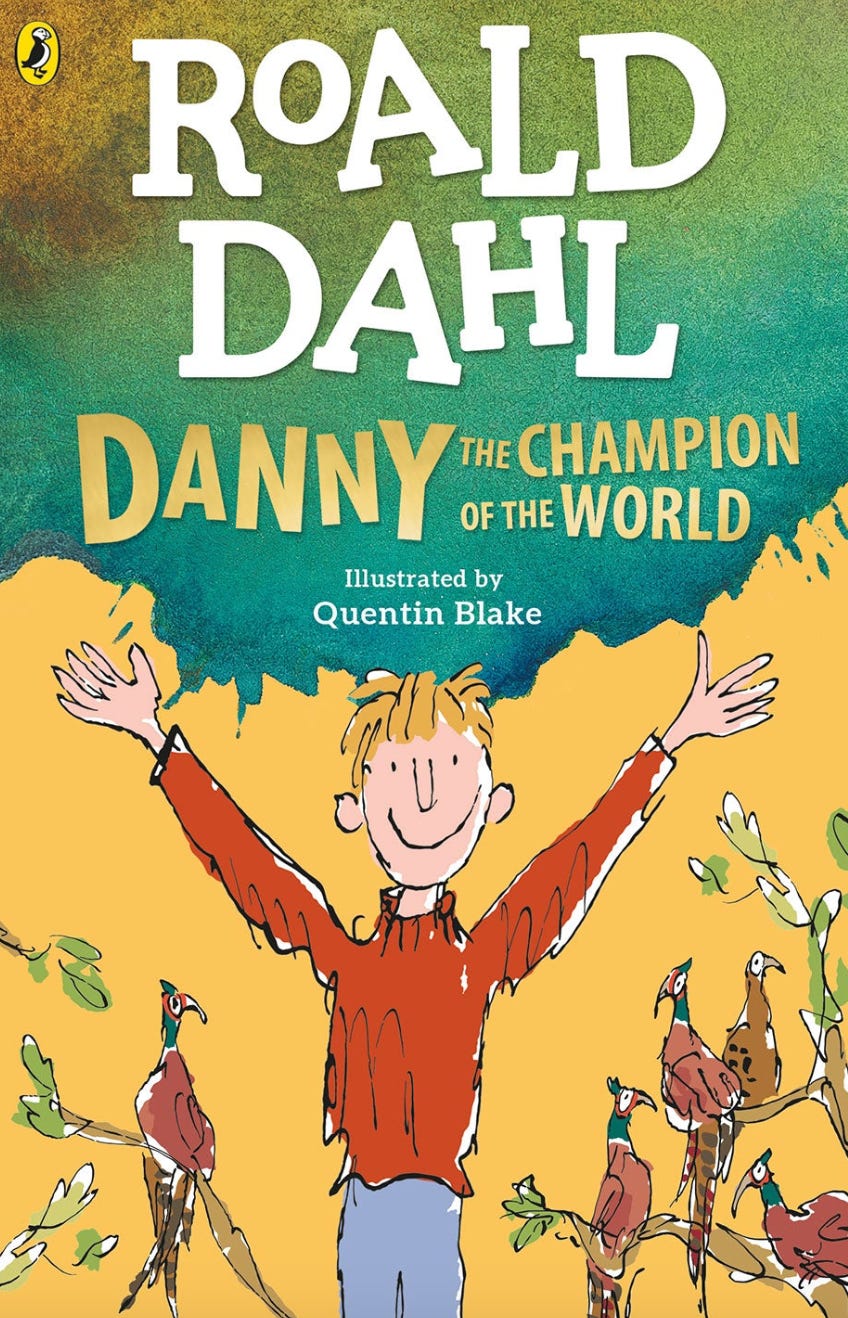
Danny the Champion of the World- by Roald Dahl ***
Danny and his dad live together in an old caravan behind a gas station, where they fix cars and craft toys together. Danny loves his dad, who bakes him delicious meat pies and tells him bedtime stories. You couldn’t possibly wish for a dad more exciting and fun than Danny’s. But one night, when Danny finds his dad’s bed empty, he discovers a deep dark secret…
Spoiler-free version
This book was a gift by my wonderful friend Lies, an avid Roald Dahl fan. It’s quite an atypical story for Dahl: there are no chocolate wizards or giants, just a heartwarming relationship between a father and son. I think that is why I could appreciate it so much as an adult. I loved how warm, wise and funny the writing could be. I wished my dad was as caring and knowledgeable as Danny’s.
Ridden with spoilers
Reading this book as an adult, I could really appreciate just how good of a storyteller Dahl is. Every detail is carefully considered to set a particular mood and prime the reader for the next step in the narrative. To take an example, there’s this chapter called ‘Cars, Kites and Fire-balloons’ in which Danny and his dad play with toys (a kite, a fire balloon, a boomerang, etc) that you could associate with ‘letting go’ and requiring trust. It’s no surprise then that in the next chapter Danny wakes up in the middle of the night to find his dad has left. It’s such a natural next story beat and noticing the craftsmanship behind it added a layer of pleasure to the reading experience.
Something else that struck me was the story’s dualistic attitude towards nature. Danny’s dad (and surprisingly many adults in the story) are addicted to poaching pheasants. To them it’s an art, an exciting sport, and effective poaching techniques are passed down from generation to generation like a valuable heirloom.
‘But we’re not starving here, Dad!’
‘You’ve missed the point, Danny boy! You’ve missed the whole point! Poaching is such a fabulous and exciting sport that once you start doing it, it gets into your blood and you can’t give it up!’ (p. 31)
Kinda fucked up, don’t you think? This weird need to dominate and manipulate the pheasant way of life is interestingly contrasted by a strong sense of respect and appreciation of animal life, most clearly seen when Danny gets educated by his dad.
'Can you hear him, Danny?'
'Yes,' I said,
'That is a bullfrog calling to his wife. He does it by blowing out his dewlap and letting it go with a burp.'
'What is a dewlap?' I asked.
'It's the loose skin on his throat. He can blow it up just like a balloon.'
'What happens when his wife hears him?'
'She goes hopping over to him. She is very happy to have been invited. But I'll tell you something very funny about the old bullfrog. He often becomes so pleased with the sound of his own voice that his wife has to nudge him several times before he'll stop his burping and turn round to hug her.'
That made me laugh.
'Dont laugh too loud,' he said, twinkling at me with his eyes. 'We men are not so very different from the bullfrog.’ (p. 109)
While the characters clearly value animal life, they simultaneously accept poaching as an honorable sport, which, I guess, must have to do with outdated values held by Dahl and his contemporaries. I can hardly imagine a children’s novel today being positive about poaching.
The excerpt above also shows just how funny and wise Dahl’s writing can be. If you haven’t read the story yet, give it a try. It just might make your old, cynical soul feel warm and fuzzy inside, as it did for me.
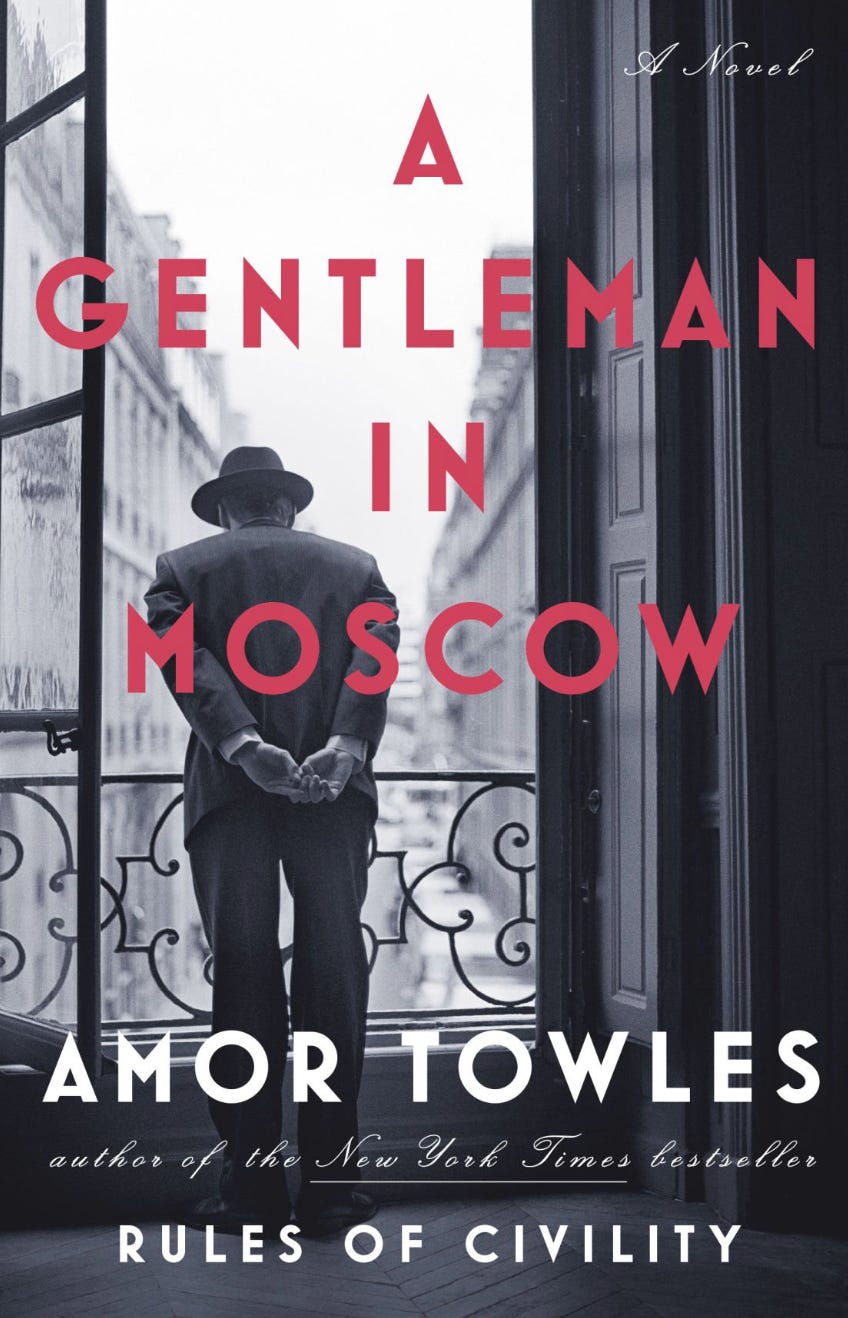
A Gentleman in Moscow - Amor Towles ***
In 1922, count Alexander Rostov is deemed an unrepentant aristocrat by a Bolshevik tribunal and sentenced to house arrest in the Metropol, a grand hotel just across the street from the Kremlin. As the years pass by, he forges strong friendships with the hotel’s denizens and discovers what it means to be a man of purpose.
The short version
I was initially very charmed by Amor Towles’ articulate writing and the Count’s endearing character. As the story progressed, however, I couldn't’ help but feel that there wasn’t much depth to the Count, nor to the story. Once I turned the final page, it felt like a series of charming hotel anecdotes had suddenly… stopped. While the novel might be about a man of purpose, the narrative most certainly lacked it.
The long version
The biggest strong suits of this novel are definitely its exquisite style and charm. This comes most to the fore in Towles’ eloquent comparisons, such as in this example, where the Count contemplates the similarity between Americans and jazz:
Like the American correspondents, jazz seemed a naturally gregarious force —one that was a little unruly and prone to say the first thing that popped into its head, but generally of good humor and friendly intent. In addition, it seemed decidedly unconcerned with where it had been or where it was going - exhibiting somehow simultaneously the confidence of the master and the inexperience of the apprentice. Was there any wonder such an art had failed to originate in Europe?
(p. 216)
But while Towels’ might confidently describe large-scale phenomena, he is less vocal about the inner workings and turmoils of the mind. As a result, the characters in the novel felt cartoonish and superficial. Staff members of the hotel are all incredibly good at their job and almost everyone is very kind and eager to become the Count’s friend.
Very dark and complex moments, such as the Count’s attempted suicide on the anniversary of his sister’s death, are never really explored. Standing on the roof of the hotel, the Count is interrupted by the hotel’s handyman who offers him honey. When tasting it, he recognizes a hint of the apples of his birthplace. This is seemingly enough for him to keep on living, but it’s up to the reader to guess why, as we’re denied the Count’s precise thoughts at that moment.
Add to that Fowles’ refusal to escalate conflicts, or tendency to resolve them so quickly you forgot there was one, and the result is a clean and comfy read that like its hotel setting, keeps its distance from the nasty ‘real’ world.
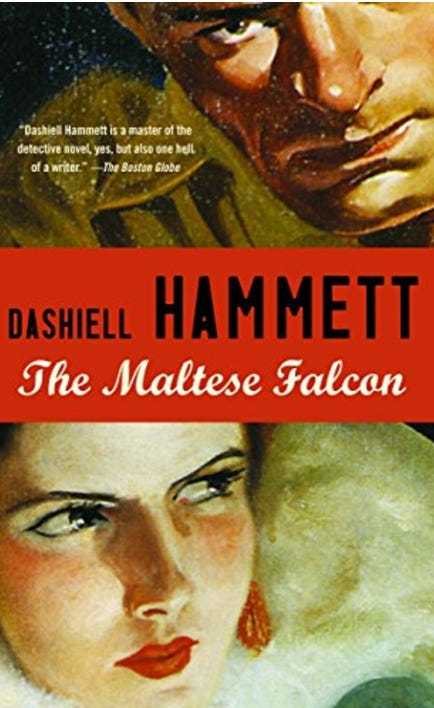
The Maltese Falcon - Dashiell Hammett ****
This foundational novel in the hard-boiled detective genre centers around private investigator Spade Archer, a volatile man with a gorgeous jawline. When he is hired by the beautiful but treacherous Miss Wonderly, he joins the hunt for the coveted Maltese Falcon in 1930’s San Francisco.
No spoilers, I promise!
Last year, I discovered the genius of an American crime writer from the 80’s, Elmore Leonard (I will have to do a review of his work someday) and since then I have been fascinated with the evolution of the American crime/detective novel. I wanted to go back and work my way through the genre’s foundational novels, so of course I had to start here, the birth of the hard-boiled detective.
Hammett’s writing style is very descriptive and detailed, it almost reads like a noir screenplay at times. We don’t get to read characters’ thoughts, everything has to be deduced from their facial expressions and reactions. While it’s with the intention of show don’t tell, it can become a bit much and slow down the tension in the story. Who cares about a person’s eye-color or face shape?
The greatest mystery in this novel is not the Maltese Falcon itself, but its characters, who slowly reveal their true motivations and personality. Spade in particular makes for a very interesting character. Sure, his over-the-top contrariness can be infuriating and he certainly behaves very inappropriately toward women (although some of that might have to do with the poor standards of Hammitt’s time) but as a lying train-wreck of a human being it is interesting to see him clash with his interlocutors. Spade is a true anti-hero. For him, everyone is a means to an end.
All in all, I really really enjoyed this novel and highly recommend it to anyone with an interest in a detective story where characters lie all the time.
That’s it for now, but I’ll be back fairly soon with a fresh batch of reviews. Until then!